
The Characters I Return To
I write about people under pressure: damaged, secretive, compromised characters trying to survive futures built by people with more power than they have. Some are decent people forced into terrible choices; some are dangerous people still capable of love, loyalty, and grace. Most are both.
My stories are science fiction, but the characters are never there to serve the machinery. The technology matters. The cities matter. The systems matter. But only because of what they do to people. I am interested in characters pushed by poverty, grief, ambition, loyalty, guilt, violence, fear, love, and the need to survive.
Alice Yu is the clearest example of this in my published work. Her world is New York roughly thirty years from now, after the technological singularity and in the middle of automation-driven mass unemployment. It is a future shaped by artificial intelligence, surveillance, crime, inequality, and systems that have become too large for ordinary people to control. But Alice matters because she is not a symbol of that world. She is someone trying to survive inside it.
That is the kind of character I keep returning to.
Not heroes born into power. Not chosen ones. Not people who begin the story already protected by wealth, status, or certainty. I am much more interested in people who have to find out who they are the hard way. People who have been damaged by the world, shaped by it, cornered by it, and then forced to decide what they will become.
That does not mean my stories have no billionaires, executives, institutions, crime bosses, or people with immense power. They do. But those characters usually act as pressure points. They are foils, mirrors, and opposing forces for the protagonists. They reveal what the main characters lack, what they fear, what they envy, what they hate, and what they might become if they make different choices.
Powerful characters create friction. They bring the opposite agenda into the room. They force the protagonist to define themselves against someone who has money, control, status, violence, or institutional authority. That contrast matters. A person without power becomes more interesting when they are forced to stand beside, fight, serve, resist, or bargain with someone who has too much of it.
Some characters become better than they expected.
Some become worse.
Most become both.
That is where the stories become interesting to me. I do not believe people are cleanly divided into good and bad, heroic and villainous, noble and corrupt. Real people are far messier than that. They can be violent and loving. Greedy and generous. Brave and selfish. Tender with one person and brutal to another. They can do terrible things for understandable reasons, and decent things for reasons that are not pure at all.
Mr. Bank, from The Paradise Factory, is one of those characters. That is not his real name. He was once a surgeon, someone who wanted to help people in the most direct way possible. But after automation helped destroy the old economy and left masses of people unemployed, discarded, and homeless, he became something much darker: the head of an organized crime gang.
That should make him easy to condemn.
It does not.
Because Mr. Bank is brutal to outsiders, dangerous, and capable of violence. But inside his own territory, he also creates a better quality of life for people abandoned by the rest of society. He gives the homeless and unemployed a district with more safety, order, care, and dignity than they would otherwise have. He is not a good man in any simple sense. He is also not simply a monster. He is what happens when compassion, rage, intelligence, trauma, and power all rot together inside a broken system.
That is the grey area I like to write in.
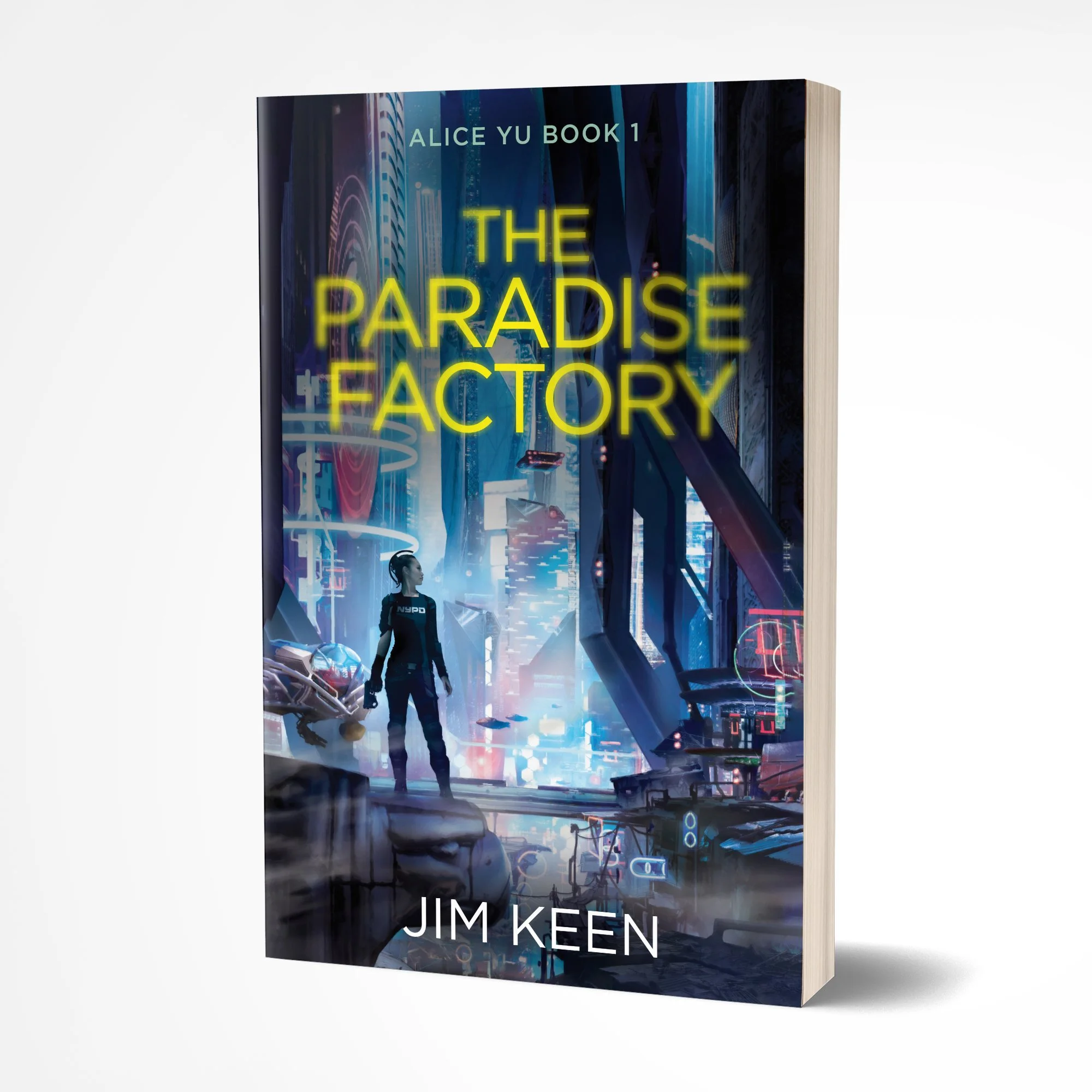
Industry Praise for "The Paradise Factory
“Gripping, thoughtful and fast paced, this is why we read science fiction! With excellent world-building, complex characters and interesting questions about humanity's future, this book will keep you turning the pages from the first word."— Matthew Goodwin, author of the 'Into Neon' science fiction series.
"A fantastic work that will delight both cyberpunk and general science fiction fans alike. The themes of machine autonomy, political conflict, and trust provide a backdrop to thrilling action scenes and strong characters..." — Mark Everglade, 'Cyberpunk Book Reviews & Interviews.'
"Escape from New York meets Cyberpunk! Instead of Snake we get Alice and she's no less badass. Perfect read for lovers of action-driven science fiction." — Anna Mocikat, author of the 'Behind Blue Eyes' science fiction series.
"An intense, captivating read. Deserves shelf space next to Gibson and Stephenson. Highly recommended!"— D.L. Young, author of the 'The Machine Killer' science fiction series.
"Jim Keen skillfully weaves real-life concerns about AI and automation together with a gripping crime thriller narrative"— Jon Richter, author of 'Auxiliary, London 2039.'
Science fiction gives me the scale to explore huge questions — AI, automation, surveillance, future cities, deep space, technical civilizations — but character gives those questions weight. A future only matters if someone has to live there. A machine only matters if it changes what someone can choose. A city only matters if it protects one person and destroys another. A system only matters if it forces people to reveal what they are willing to do.
The characters I return to are usually carrying secrets. Sometimes those secrets are crimes. Sometimes they are memories. Sometimes they are shame, grief, hidden loyalties, old identities, buried violence, or private hopes they barely admit to themselves. I like characters who are not entirely sure whether they are saving themselves, damning themselves, or doing both at once.
That is true in the Alice Yu stories, and it will remain true in Fleet Obscura.
Fleet Obscura is set in the same wider universe, roughly a thousand years later. The scale is much larger: deep-space vessels, expeditionary systems, technical records, unknown worlds, frontier routes, and a future civilization pushing into unmapped regions of space. But the characters will still be the center of it. Not perfect explorers. Not flawless officers. Not clean-cut representatives of progress. People.
People under pressure.
People with pasts.
People making decisions in environments that do not care whether they survive.
That is what character-first science fiction means to me. The future can be vast, strange, beautiful, terrifying, and full of extraordinary machines, but the story begins when someone inside that future has to make a choice. Not an abstract choice. A human one. The kind that costs them something.
I return to characters who are trying to understand their own values in worlds designed to crush, tempt, distort, or erase them. I return to people who are both better and worse than they want to be. I return to those caught between survival and morality, loyalty and ambition, love and violence, guilt and necessity.
Because that feels true.
Because whatever the future becomes, it will still be full of people trying to live with themselves.
Jim
As important as characters and settings are themes, which I go into more detail here:
